
BD Rowa SynMed™ & National Pharmacies Group – Talk Automation.
Sam, could you tell me a bit about yourself, your role, and the National Pharmacies group?
I grew up in Townsville and graduated from James Cook University as a pharmacist 20 years ago. I am currently the General Manager Health Services within National Pharmacies in Adelaide and lead a team of experts including our Growth and Innovation Manager, Chief Pharmacist, Health Services Manager, Professional Services Coordinator and Sleep Apnoea Coordinator.
Our Health Services team is responsible for National Pharmacies’ clinical governance, service delivery frameworks and administration, service excellence initiatives and growth and innovation activities. Our recent organisational successes include direct involvement in the Automatic External Defibrillators (AED) installations outside all National Pharmacies stores in SA, Victoria and News South Wales, the Pharmacycle medication blister recycling program and, most recently, the 24/7 Pharmacy launch at Norwood National Pharmacies as part of a State Government initiative to increase access to health care.
Adoption of a Hub-and-Spoke Model:
What led to the decision to adopt a hub-and-spoke model for DAA (Blister-packs) packing at National Pharmacies, and how did the BD Rowa SynMed ULTRA Automation Robot fit into this strategy?
Firstly, as a mutual organisation, we are unique in that all our 44 community pharmacy sites are coordinated and supported by a head office structure. As we do not have separate pharmacy owners, our decision-making process can be more streamlined. Having the Growth and Innovation function within my team constantly challenges our way of thinking and doing things.
We have been aware of DAA (Blister-packs) technology for decades and have rigorously modelled internal opportunities as new technologies enter the market, but until the SynMed™ machine came along, the numbers didn’t stack up for our business.
Draw to BD Rowa SynMed Technology:
What was it about the BD Rowa SynMed Technology that drew you to pursue it, and what performance and scalability did that allow you to achieve in the context of your operations?
Given our previous modelling activities on market technologies, we were well-positioned to move if a machine entered the market that met our internal decision-making criteria. It was at the Australian Pharmacy Professional conference in 2022 where a colleague from Germany – who knew the BD Rowa SynMed™ ULTRA system would potentially suit our business - introduced me to Michael Beck and Dr Paul Gooden from Med-ID.
We commenced discussions and moved quickly to a decision to proceed.
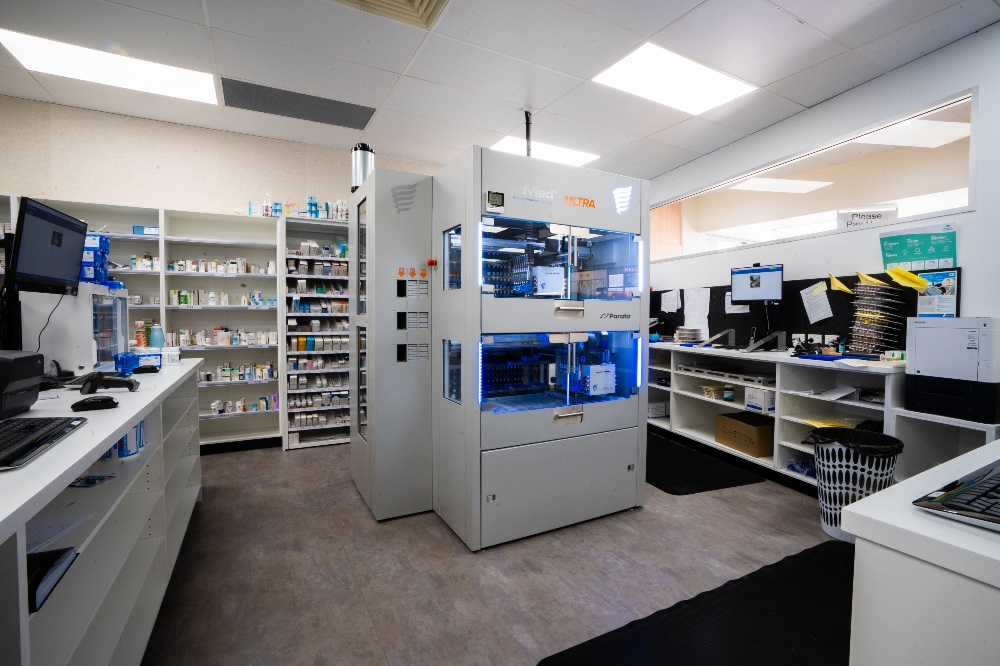
The actual technology was advanced and well-proven in North America and Europe. The machines are very robust and unique as they are built using “pick and place” technology, which is essentially using suction pipets to pack multiple pills at once without damage.
We also carry over 95 per cent of our medications within the machine, this is due to the 508 RFID canisters on board. More medications packed, means less manual packing, in turn increasing safety and efficiency.
Finally, the biggest game changer is that we do not have to send our canisters overseas or back to the manufacturers to recalibrate for new medications. We can now do this in house in 10 or so minutes, saving valuable time.
Overview of Goals:
Could you provide an overview of the project to in source the DAA (Blister-packs) packing process using the BD ROwa SynMed ULTRA Automation Robot? What were the key objectives you aimed to achieve with this initiative?
Our objectives considered multiple components to improve; patient (member) safety, dispensary efficiencies, supply chain and logistics, commercial elements, member value and consistency, and service growth opportunities.
Once we decided to implement, we assigned our Growth and Innovation Senior Manager, Bill Lelas, to lead the project, with assistance from myself, General Manager Finance Rob Quinton and Senior Manager Technology Nick Martin.
The project took three months and, given our installation was unique, we held weekly project steering meetings which aided in a smooth implementation process.
Integration with Existing Systems:
Integrating new technology with existing software and systems can be challenging. How did you manage the integration of the BD Rowa SynMed ULTRA Automation Robot with Webstercare's software and card system to further improve medication safety?
Software was a challenging issue for us. Our DAA (Blister-packs) software (Webstercare) did not feature an integration with the BD Rowa SynMed™ Robot at that point in time.
We wanted to minimise potential disruption to our pharmacy teams, especially in the environment of the time where we faced challenges with pharmacist COVID-19 burnout and workforce shortages. We wanted to avoid the imposition of a software change at all costs and Med-ID recognised this.
Therefore, as part of our agreement, we worked closely with both Webstercare and Med-ID to agree to an integration being developed, and we were the first Med-ID customer to achieve this in the Australian market.
Efficiencies and Cost Savings:
Could you share some insights into the efficiencies and cost savings realised through this automation? How has it impacted the overall operation of National Pharmacies?
We have decades of experience with other types of dispensary automation, so we held similar expectations with automation of DAA (Blister-packs) packing.
With well-known healthcare sector challenges, pharmacists and dispensing teams are evolving to doing more with examples such as vaccinations, expanded services, and scope-of-practice. We saw DAA (Blister-packs) automation as an opportunity to remove the manual DAA (Blister-packs) packing activity and increase capacity for our teams to deliver on new initiatives.
Our goal with centralisation or “hub and spoke” was to remove the potential pressures of daily packing from the pharmacies (spoke) to the centralised automation (hub). At the hub, our staff’s expertise is focused on delivering a professional, accurate and scalable product.
The centralisation gives us scalability without large additional costs too. This also helped the business case stack up.
At a simplistic level, if a DAA (Blister-packs) is manually packed at 6 packs/hour, we are seeing rates between 60- 75 packs/hour. The efficiency gain is quantifiable, real and has a significant impact on the business!
Our objective was to automate 90 per cent of our total packs and this has been achieved.
Design and Construction of the Production Facility:
The production facility's design, including natural lighting, airflow, and visibility to customers, seems to have been a priority. Can you discuss the importance of these elements and how they were incorporated into the facility's design?
When it came to design, we trusted the Med-ID team to plan the close-proximity robotic workspaces given their experience. Michael Beck and Dr Paul Gooden (from Med-ID) helped guide important features of the general facility, such as lighting, logistics zones and staff facilities.
Additionally, we had internal team members support key areas relating to functional movement and safety of our staff, including our WHS Manager and Occupational Therapist.
Staff Satisfaction and Operational Excellence:
How has the new production facility, with its emphasis on high standards for operational areas and staff satisfaction, impacted the pharmacy team's morale and productivity?
The facility began operating with three full-time staff in July 2023 and is currently running smoothly with four full-time staff. Our internal processes have reported exceptionally low error rates.
When it came to establishing our facility team, we had strong interest in the recruitment phase from both internal and external applicants. We ultimately appointed Brad Price, a pharmacist in our company for 20 years, to facility manager. Brad has provided exceptional leadership to this new initiative and has been supported by a highly engaged and competent team.
Our frontline pharmacy teams have provided great feedback on the initiative and our facility team was nominated for an annual award in 2023 after just a few months of operation.
Challenges and Lessons Learned:
Could you share some of the challenges faced during the implementation of the BD ROwa SynMed ULTRA Automation Robot and the hub-and-spoke model, and what lessons were learned?
This project required many inputs from a number of internal departments, from operations and IT, to finance, supply chain, people and culture, legal, marketing, and others. The project also required inputs from external stakeholders including Med-ID (automation company), Webstercare (software), shop-fitting and other DAA (Blister-packs) automation.
Given the sheer number of stakeholders, one of the best decisions we made was assigning a project manager to coordinate all interested parties through regular steering meetings.
Of course, we had the odd surprise, but we gave ourselves time to constructively work through these areas and collectively work on solutions for positive outcomes - a testament to all partners involved in this project.
Advice for Other Pharmacies Considering Automation:
Based on your experience, what advice would you give to other pharmacies considering the implementation of automation and a hub-and-spoke model to enhance their operations and customer service?
Given our unique position as a mutual organisation, the following advice may vary in its relevance for some, however the main suggestions should be universal and include:
- Scheduling regular project meetings before installation to ensure a smooth process.
- Prioritising change management – involve your pharmacies (or pharmacy customers) throughout the journey and maintain frequent communication.
- Establishing clear expectations regarding the facility's functionality.
- Developing a comprehensive onboarding phase, incorporating contingencies for both facility and network, particularly during the initial three to six months.
- Conducting frequent reviews between the facility and dispensing teams (customers) to address and resolve any issues.
- Maintaining regular communication with supply partners (automation and software), even after installation.
- Conducting periodic facility reviews and establishing clear Key Performance Indicators (KPIs) for evaluation.
- Operationally, make sure that the production team use the SynMed™ Productivity Reports for continuous improvement.
- Ensuring that there is a clear supply chain process of medications and consumables at all times. This includes a clear process of supply, deblistering, and replenishment.
- Ensuring that all medications are deblistered and ready for filling the machine. The SynMed™ will churn through a very high volume of pills, far more than we have ever seen.
My last recommendation would be to reach out to the team from BD Rowa SynMed™ and Med-ID to start a conversation today.
About Med-ID:
Med-ID Pty Ltd is the exclusive proud partner of BD Rowa SynMed™, specialising in automation for pharmacies. With systems in all mainland states and a team covering Australia, Med-ID is well positioned to assist with sophisticated automation, integration and pharmacy requirements.
"A Call to Pharmacists to Unlock Better Care and Sustainable Revenue Growth Through BD Rowa SynMed™ Automation”.
Find out more: To learn more about BD Rowa™ Technology, you can visit the website: bd.com/rowa